Why the harness gets the credit
Harness engineering has hugely grown in popularity throughout 2026, with many people touting the harness as being more important than the model.
 Greg Brockman@gdbthe model alone is no longer the product22 May 2026Open on X →
When you look at results such as Prime Agent’s performance on ARC-AGI-3, it’s easy to understand why so much attention has been placed on the harness.
 Prime Intellect@PrimeIntellectPrime Agent is a general-purpose coding harness
On ARC-AGI-3, it scores 95.5%, surpassing the human-expert baseline, but the gain is not benchmark-specific.
We see major improvements across models when compared to their proprietary harnesses:
Prime Intellect@PrimeIntellectPrime Agent is a general-purpose coding harness
On ARC-AGI-3, it scores 95.5%, surpassing the human-expert baseline, but the gain is not benchmark-specific.
We see major improvements across models when compared to their proprietary harnesses: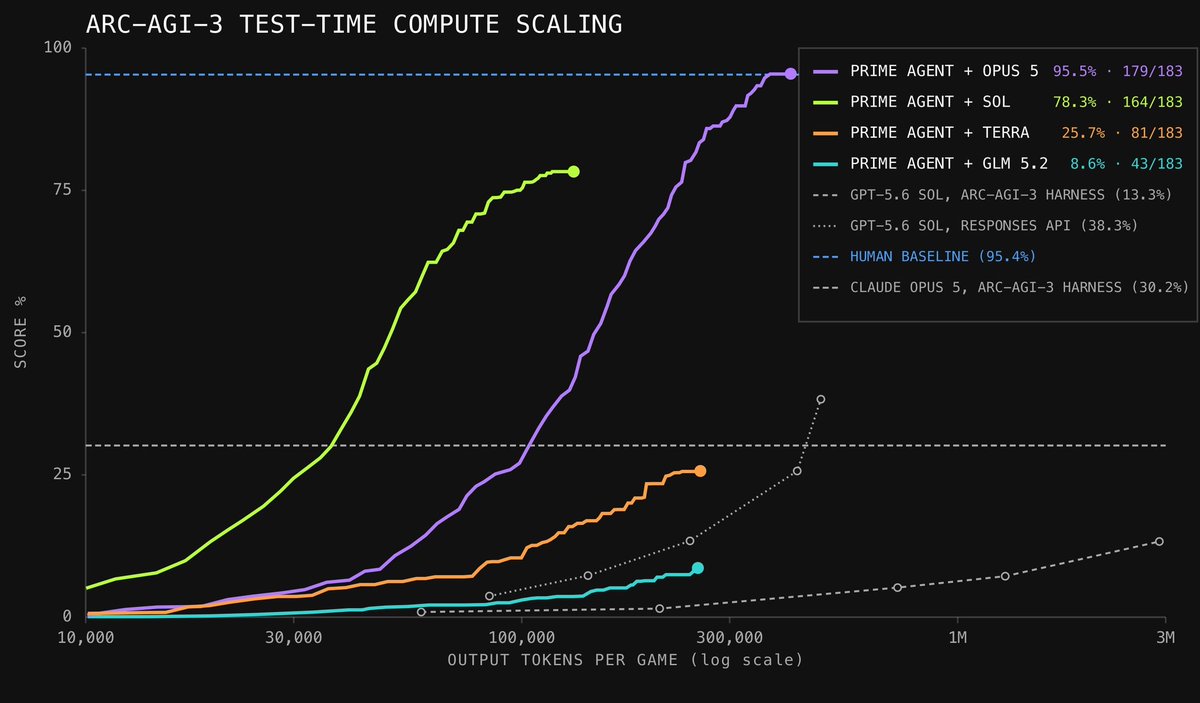 5 Aug 2026Open on X →
In a world where the state-of-the-art models behave like an autistic genius with amnesia, harness engineering is the lowest hanging fruit to provide genuine statefulness, learning from experience, and skill acquisition, whilst still being able to leverage all of the power of in-context learning of the most powerful closed-source foundation models.
Notepads and tattoos
If we compare an agent to a person, then our current agents behave like Leonard Shelby from Memento, continually scribbling down experience onto endless notepads (would need to be very finely printed tattoos), and hoping they didn’t forget anything important.

Leonard Shelby in Memento (2000). He can only remember the last few minutes, so everything else lives on a Polaroid, a note, or his own skin. Still: Newmarket Films.
Personally, if I had to proactively write down everything I needed to remember, and explain every future skill purely in textual form, then I would also suck at remembering and learning things. It’s no surprise that our brains do not store things as a collection of word documents, and it’s no surprise that these harnesses are notoriously brittle and unreliable.
A point-in-time solution
With this in mind, harnesses such as openclaw, hermes-agent, prime-agent, claude code, opencode, and codex are just as much of a “point in time” solution as hand-crafted vision filters were in the 2000s.
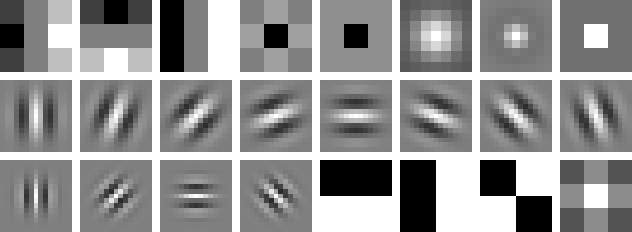
Hand designed edge detectors, line detectors and bag-of-words predictions gave way to end-to-end learned filters with the advent of CNNs. The implicitly learned filters were far superior to anything that a human could design.
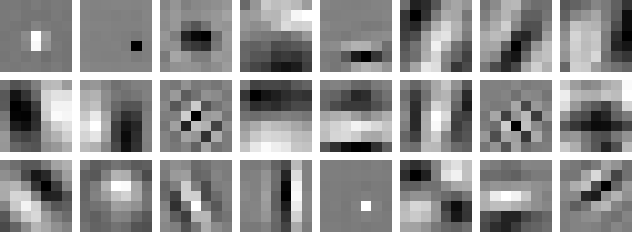
Human designed harnesses will give way to continual parametric learning in much the same way.
To be clear about what a harness is, it isn’t just the notes. OpenClaw, Hermes-Agent, OpenCode and the rest decide when the model gets called, what goes into its context, which tools it can reach, when to compact, when to spin up a sub-agent, and how to check the result. The model is one component inside that system, and today most of what makes the system good is the orchestration around it. That is why the harness gets the credit, and to be fair, right now it deserves it.
But every one of those decisions is a human guess about how a model should be used, written down in code and prompts. That is exactly what a Sobel filter was: a human guess about which pixel patterns matter, written down as nine numbers. The guesses were reasonable, and they were still beaten the moment the pixels could be learned from.
I don’t think the harness disappears. In the version I’m working towards it is still there and still maintained, but its job changes. Rather than being the system, it becomes the scaffolding around a model that learns at test time: deciding which experience is worth training on, running the update, and checking that it worked. Kind of like how a CNN still needs a training pipeline of data loaders and optimisers, but nobody would call the pipeline the vision system. The model is the system, and the scaffolding exists to keep it learning.
Why not continual learning already
So why don’t we have continual learning already? Don’t ChatGPT and Claude Code “learn” about me when I use them? The short answer is no they don’t. They store textual files about you, which must then be re-read every time you engage with the model. The reason for these simple hacks is simple: a lack of compute. Maintaining a separate LoRA adapter for each of the billion+ users of ChatGPT would require an insane amount of extra compute, and OpenAI is already rumoured to be operating at a loss. Keeping one frozen network, and then batching together thousands of user requests into a single forward pass is much more economically feasible than having each user engage with their own personally evolving model, with its own unique set of weights evolving based on all interactions with said user.
What changed
In-harness learning made sense in early 2026, as the closed-source foundational models were all substantially better than the open source alternatives, and so parametric learning wasn’t really an option if you wanted to leverage the best models. Things have now changed though. Much smaller open source models are catching up, and for the first time, this has opened the door to fully personalized continual learning, all on your own device, with a model that you own.
At unify, we’re pushing the frontier to make this continual learning possible.